
A Science Strategy for the Human Exploration of Mars
Dr. Jonathan Jiang, as an Astrophysicist, serves on the National Academies of Sciences, Engineering, and Medicine committee to address the topic of “High Priority Science Campaigns for Human Explorers on the Surface of Mars.”
A Science Strategy for the Human Exploration of Mars will identify high priority science objectives (in all relevant disciplines) to be addressed by human explorers across multiple science campaigns on the surface of Mars. This includes identifying and prioritizing science objectives from the relevant decadal survey reports and discipline roadmaps and NASA’s Moon to Mars Objectives, determining types of samples to be collected and measurements to be taken, identifying science campaigns to address the objectives, and identifying preliminary criteria for the selection of appropriate landing sites.
Mars Committee
Linda T. Elkins-Tanton
Dominic Antonelli
Christopher E. Carr
Jonathan H. Jiang
Pascal Lee
Nilton O. Renno
Julianna M. Scheiman
Erika B. Wagner
Dava J. Newman
Penelope J. Boston
Barbara A. Cohen
James F. Kasting
James A. Pawelczyk
Michael G. Ryschkewitsch
Wanda A. Sigur
A Science Strategy for the Human Exploration of Mars: Charting a New Course for Humanity’s Next Giant Leap
On December 9, 2025, the National Academies of Sciences, Engineering, and Medicine released its landmark consensus report, A Science Strategy for the Human Exploration of Mars. This publication reflects years of dedicated collaboration among experts in planetary science, engineering, human health, mission architecture, and astrobiology. As a member of the committee, I am honored to share the vision we have shaped, a scientific blueprint that unites rigorous inquiry with humanity’s enduring desire to explore beyond Earth.
The timing of this report is pivotal. NASA’s Artemis program is laying the foundation for sustainable human operations on the Moon, and Mars now stands clearly as the next frontier. Yet the central question extends beyond the schedule of a future landing. It asks what scientific purpose will guide and justify the most ambitious exploration endeavor in human history. Mars, with its ancient oceans, volcanic terrains, and remarkably preserved geological archive, holds the key to some of the greatest questions in science: Did life ever emerge elsewhere in our solar system? Could remnants of ancient, or even present-day, life still exist in protected environments? And what does Mars reveal about the evolution of planets, including our own?
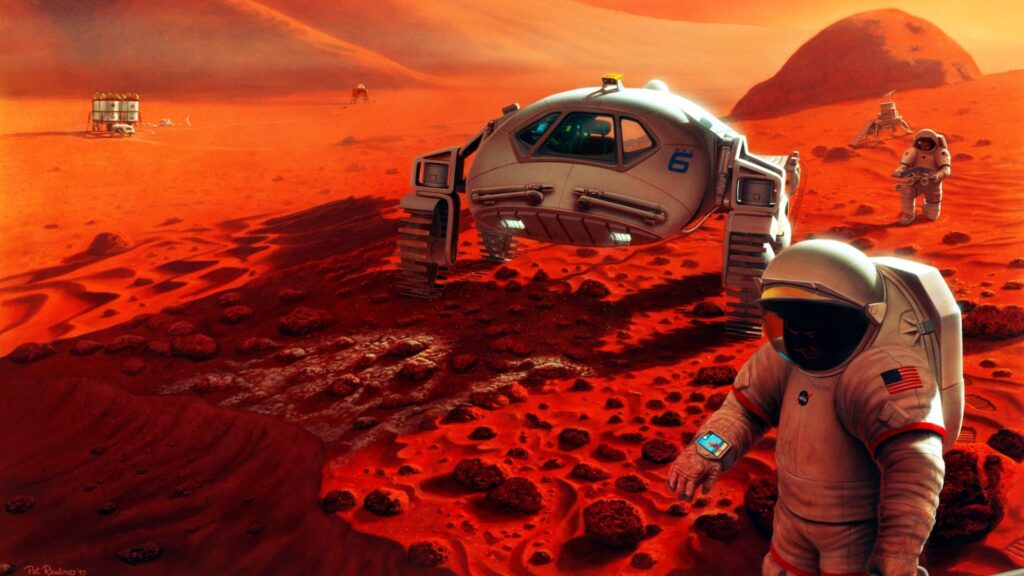
The strategy outlined in the report places these questions at its core. Determining whether Mars hosts extinct or extant life remains one of the most compelling motivations for sending humans to the Red Planet. Human explorers bring capabilities that no robotic system can match: rapid reasoning, adaptable sampling strategies, deep drilling, and real-time interpretation in complex terrain. Their presence will elevate the search for biosignatures from remote detection to systematic field science.
The report also emphasizes the importance of reconstructing Mars’ climate and geological history and identifying potential “niche habitats” where microbial communities may once have thrived. Mars preserves a planetary record that Earth has largely erased through tectonic activity. Humans on Mars will be uniquely able to analyze this archive directly, improving our understanding of planetary evolution, atmospheric loss, and the origins of habitability.
Beyond planetary science, the report highlights the scientific opportunities inherent in the challenge of human survival on Mars. Understanding radiation exposure, dust toxicity, circadian disruption, psychological resilience, food production, and habitat stability is essential for long-duration missions. Each challenge presents a chance to deepen our understanding of human biology under extreme conditions, advancing both space exploration and health sciences on Earth.
Sustainable exploration will also require learning to use local resources. The strategy underscores the need to demonstrate in-situ resource utilization, transforming Martian water and carbon dioxide into oxygen, fuel, and building materials. At every stage, responsible planetary protection remains a guiding principle, preserving both Martian environments and Earth’s biosphere.
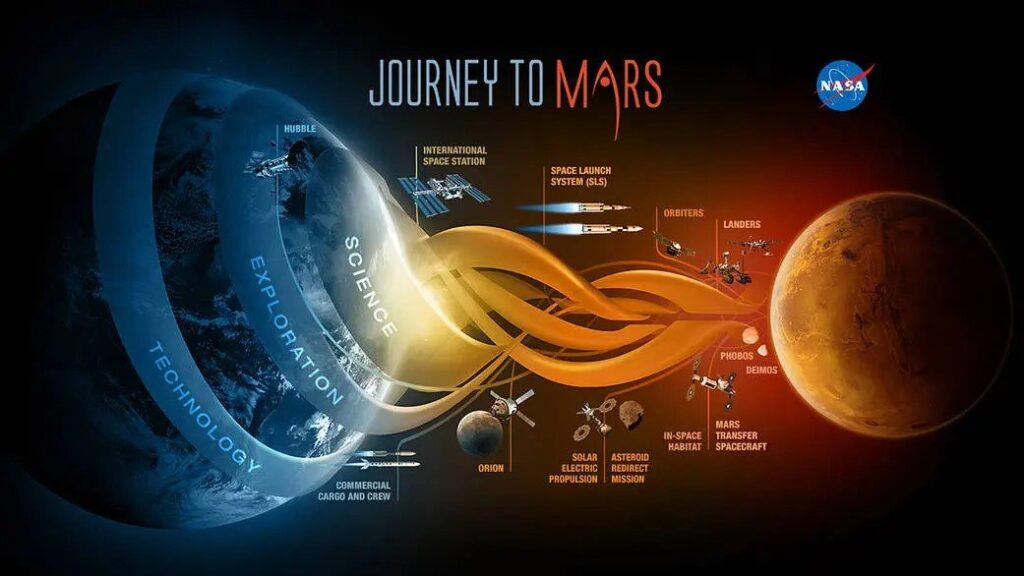
Together, these priorities form a coherent, forward-looking roadmap for human exploration. The report envisions a phased approach, from Earth-Moon preparatory missions to early human landings on Mars, and ultimately to a sustained scientific presence capable of decades of discovery.
For millennia, humanity has looked at Mars with wonder, imagination, and longing. Today, that longing is being transformed into a strategy grounded in science, collaboration, and purpose. With the release of this report, we take a decisive step toward turning the dream of human exploration of Mars into reality.
Mars has waited for billions of years. With a clear strategy now in hand, humanity is preparing to take its next giant leap across the cosmic shore.
Dr. Jonathan H. Jiang